The phone Built at On Point Pizza
It picks up on the first ring and rings the order in.
An AI host that knows your menu, your prices and tonight's wait. It takes the order, reads it back once, and puts it straight into your Clover as a real order. The ticket prints in the kitchen at the register's own prices.
Fifteen minutes with Chris, the owner of On Point. He shows you his own shop running on it.
Every call recorded, with the transcript next to the order it made. 400 minutes a month included. Two months free on your real line.
On On Point Pizza's main lineNarragansett, Rhode Island. Every call to the shop is answered by SoFire, and its orders land in the shop's own Clover and print in the kitchen.
Every call recordedTap a call and it plays, with the transcript under it and the order it made beside it.
Every call picked upThe telemarketer at four o'clock, the wrong number, the guy asking your hours, your crew testing it. Nobody in the kitchen stops for any of them.
Every ring pulls somebody off the line.
Seven o'clock on a Friday. Two people on the make line, one on the oven, six people in the lobby, and the phone goes. Somebody picks it up with flour on his hands, holds it against his shoulder, and shouts across the kitchen to ask what the wait is.
That call took ninety seconds. What it cost was whatever he was in the middle of, and he was in the middle of something, because it's seven o'clock and everybody is always in the middle of something.
Then it goes again nine minutes later. And again. By close it has happened forty times, and another person on the schedule doesn't fix it, because the ring doesn't land on a job title. It lands on whoever is closest.
You don't notice what it was costing until it stops.
The owner of this shop put an AI on his line, and it took the better part of a week to put a finger on what had changed: the same people, finishing what they started.
| Time | The call | |
|---|---|---|
| 6:41 | OrderOff the dough | Order |
| 6:47 | "You open Sunday?"Off the cut table | Question |
| 6:52 | Rang outNobody had a free hand | Lost |
| 7:04 | OrderRegister, customer standing there | Order |
| 7:11 | OrderOff the dough again | Order |
| 7:22 | "How long's the wait?"The oven again | Question |
| 7:26 | OrderOff the cut table | Order |
| 7:33 | Hung up on holdNinety seconds of it | Lost |
Half the calls aren't orders. Nobody has to pick them up.
One month at the shop it was built in, the phone rang 2,128 times. 1,062 were orders. The other 1,066 were robocalls, card processing pitches, wrong numbers, "are you open Sunday," and other AIs calling to sell something. The service the shop used then billed every one of those by the minute.
SoFire picks up every one of them so nobody in the kitchen has to. Every call is on your list with its recording, so you can see what each one was.
A call, start to finish
Nothing here is a script it reads off. It knows the menu the way your crew knows it, and the wait the way the kitchen screen knows it.
On Point Pizza, what can I get you?
Yeah, can I do a large pepperoni and an order of chicken fingers?
Sure. Fingers come three piece or six, and you want fries with those?
Six, no fries. And is the Chicago Fire spicy?
It's got hot peppers and crushed red pepper on it, so it's got some kick. Want me to add one?
No, just the pepperoni. How long?
About forty minutes tonight, it's busy. So that's a large pepperoni and a six piece chicken fingers. Can I get a first name?
Mike.
Got it, Mike. You're all set, ready around quarter of eight.
What it knew without asking anyone
- That fingers come in two sizesBecause it reads your real menu from the register, with every option on it. It asks the question your best phone person asks, and it asks it once.
- That tonight is forty minutes, not half an hourIt reads the wait your crew set on the kitchen screen. One place to change it, and the phone and the order page change with it.
- What's 86'd right nowMark something out in the app and the phone stops selling it that second.
- Who's callingA regular gets "I have this under Mike, is that right?" instead of being asked for a name every time.
What it looks like
Screens straight from the app.
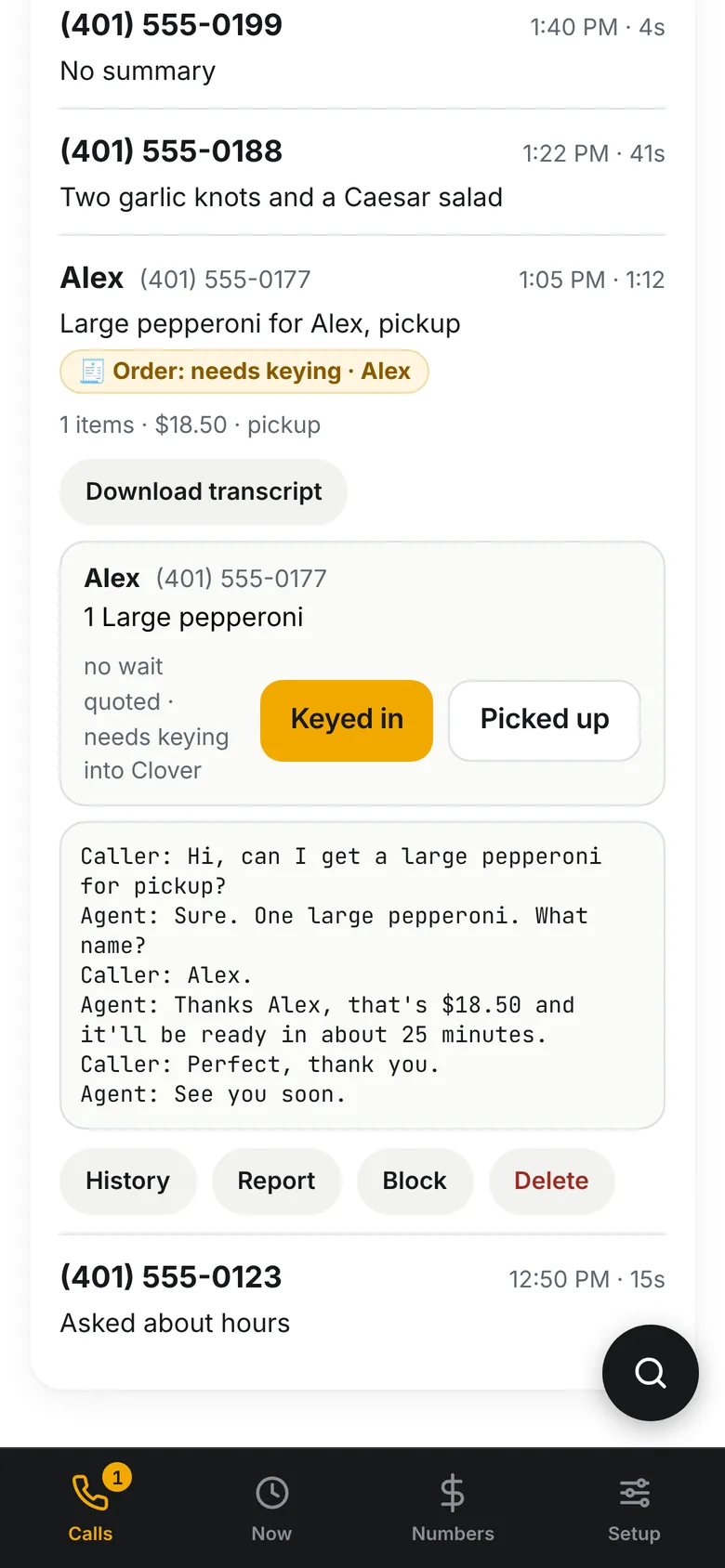
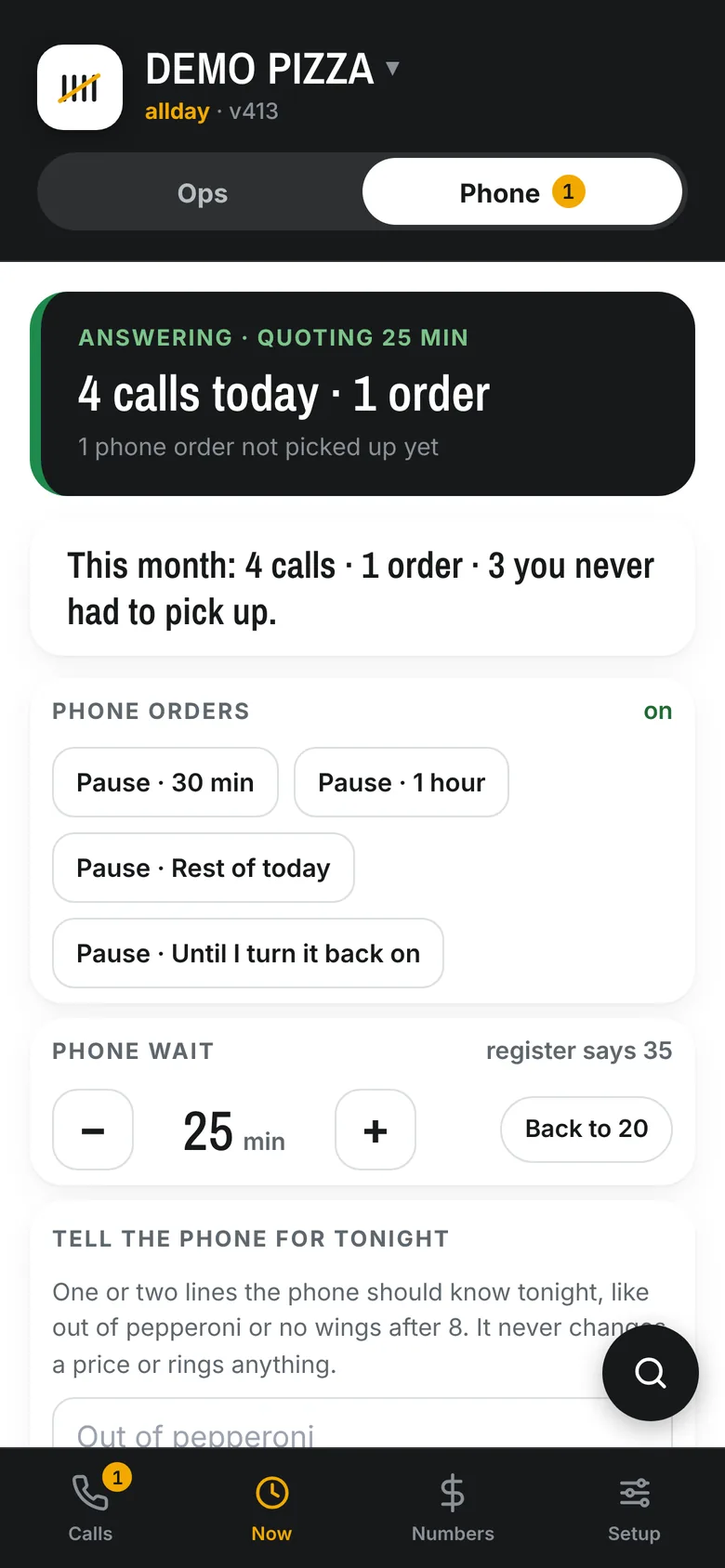
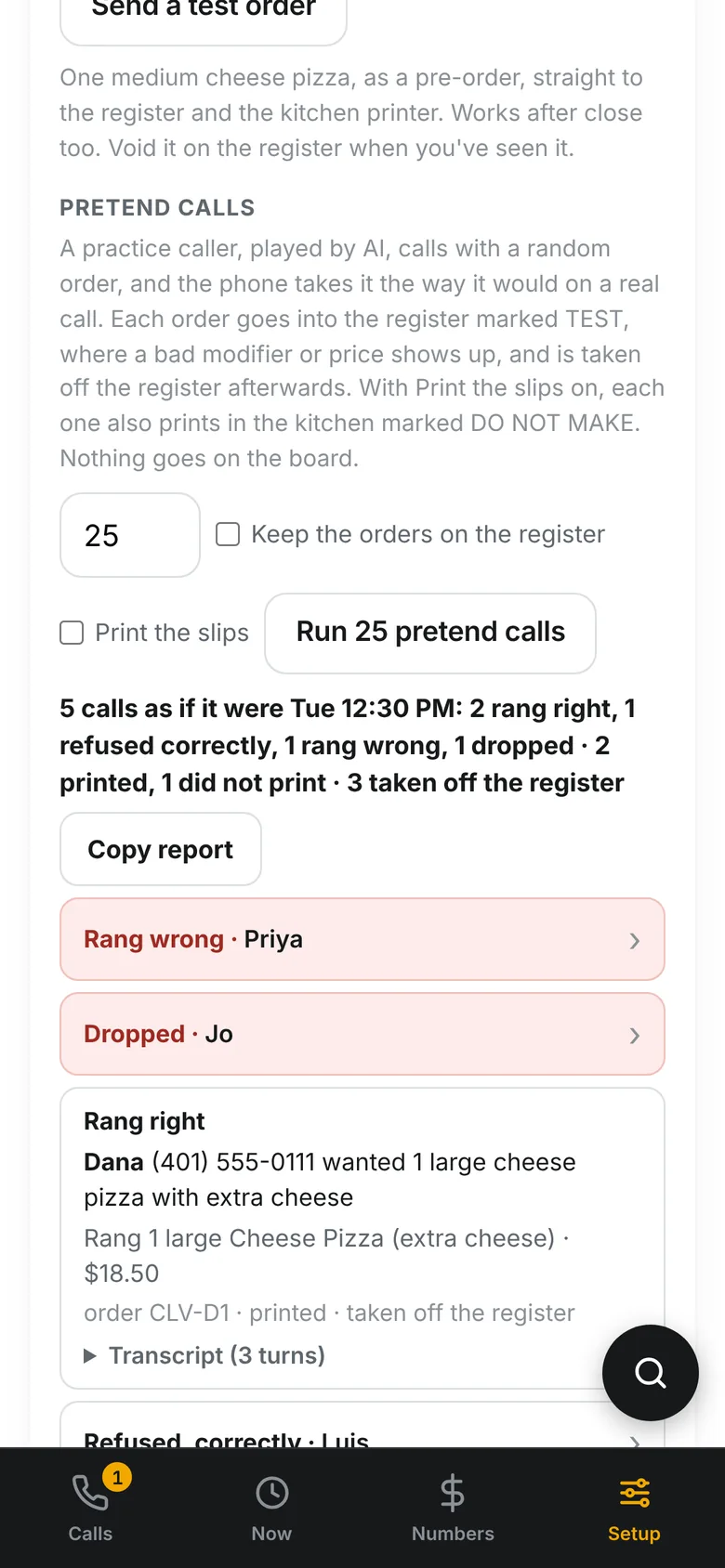
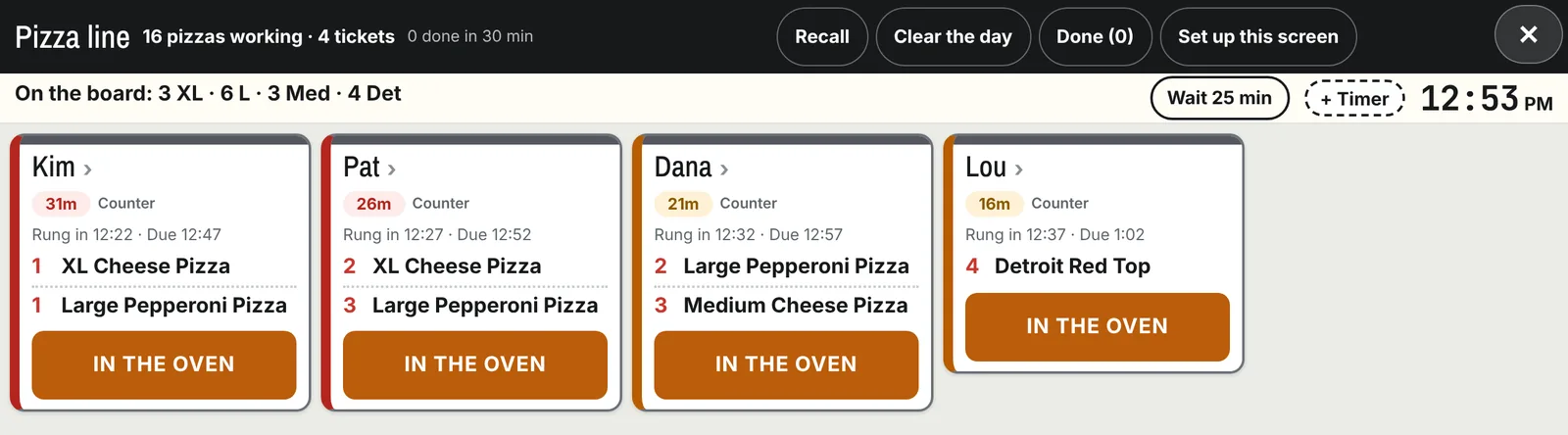
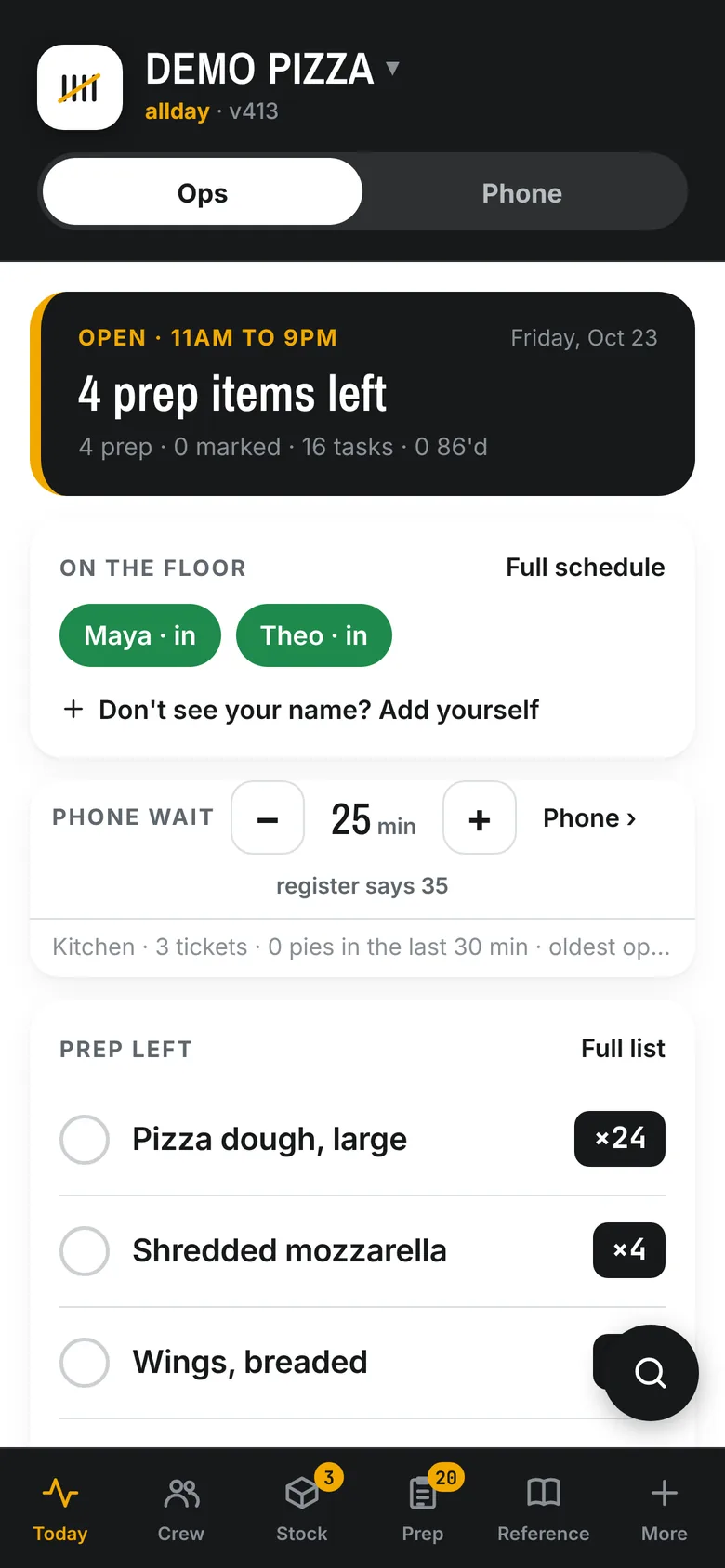
Swipe for more. These screens show a sample shop with made up names.
Two ways to run it
You don't have to hand over the phone on day one. Start with the second one and move to the first when you trust it.
It answers everything
Nobody in the building picks up the phone unless it hands them a call.
- Every call, first ringthe four o'clock robot, the guy asking your hours, and the twelve orders between six and seven
- You only hear from it when it matterssomebody asking for a person, a complaint, something it won't guess at
- The phone stops being a fire alarmwhen it rings now you look up, because it means something actually needs you
It catches the overflow
Your line rings first. It picks up the ones you can't get to.
- Busy, or four rings, and it takes overwhoever's on the register stays with the customer in front of them
- The calls that used to ring outare the ones it catches, and those were pure lost money
- Good for a short nightsomebody calls out, you're one down, and the phone is still covered
Nobody's job goes away. Somebody from the kitchen always ends up stuck on that phone with flour on their hands. Now they're on the line, or with the customer standing in front of them.
You can change your mind at any hour. Pause it for an hour, the night, or until you say, and it still picks up and gives people your hours. Switch it off and the line rings the way it does now.
You can hear every call it took
Tap a call and it plays. That's the first thing on the row, before the transcript, because when an order comes out wrong you don't want to read about it. You want to hear what the customer said.
The order is right there beside it. The recording, the transcript and the order it made, on one row. Your managers can pull them up too, so when you're not in the building, the person who is can sort it out without calling you.
The history stays. We don't wipe it after a week. Last Friday is there, and the Friday before it, which is the only way you get to ask "is this guy calling every week to complain?"
What it does when it doesn't know
This is the honest part, and it's the question every owner asks second.
It asks, once
"Chicken parm" is a grinder, a pizza and a side at most shops. It asks which, in your shop's words, and never picks one by itself. Asked something it can't answer from your menu, it says it'll get them a real answer rather than making one up.
It hands the call over
Ask for a person and you get one. Complaints about a previous order, refunds, anything about money, anything it isn't sure of. Those go to the counter, or to whatever number you point it at.
It never lies about a pizza
If it can't reach the register, the order lands in the app, flagged loud on the kitchen screen so somebody keys it in, and the caller is told they're all set, never that the kitchen already has it. A phone that lies about a pizza is worse than one that rings.
How the order reaches your kitchen
It goes straight into your Clover through Clover's own door. No middleman, no outside service in between. The order is made of your real menu items, so the register prices it, not us. It goes in under your own Pickup order type, and it fires your kitchen printer the same as a ticket rung in at the counter. No new hardware, no new screen for the crew to learn, unless you want the kitchen screen, which shows phone orders next to everything else.
Your menu is read from the register, not typed in by us. Change a price on Clover and the phone quotes the new one on the next call. Add a special on the Menu screen and it sells it that night.
| 1. The call | SoFire answers |
| 2. Read back once, confirmed | with the caller |
| 3. Created in your Clover | your items, your prices |
| 4. Under your Pickup type | name and number on the ticket |
| 5. Prints in the kitchen | Same printer |
What it costs
No flat rate with a catch buried in it. Here is the deal.
SoFire AI Answering Built at On Point Pizza
$199 a month, the founding rate, covers your first 400 minutes on calls. Past that it's 50¢ a minute, and the bill stops at $999 a month. It never goes past that without your yes.
The shop it was built in had 2,360 minutes of calls in a month and paid $1,416 for them at 60¢ a minute. On SoFire that month is $999.
Spanish speakers in Spanish. An add on at $49 a month: it answers in Spanish and rings the order the same way.
It runs on any tier, or by itself. It reads your menu, your hours and your 86 board from the register either way. Add Line or Kitchen when you want the rest of the shop.
then 50¢ a minute
never more than $999 a month
$100 setup after the free months
Spanish add on $49 a month
Two months free
They start the day it answers its first real call on your line, not the day you sign up. Card on file, nothing charged until they end, when the $100 setup is charged. A week before the first bill you get a note with what a normal month would have cost, so there are no surprises.
By then you've listened to two months of your own calls. You'll know what it's worth before you pay for it.
Why by the minute. It's how a phone call is measured, and it's the easiest bill to check. About two minutes an order, so the 400 minutes cover about 200 orders, and the cap means a busy month can't run away from you.
No contract, and you can check the meter. Every minute it billed you for is a call in your list, with the recording. Turn it off at the end of a month and the phone rings the way it does now.
What owners ask about it
Does it sound like a robot?
It sounds like a person behind a counter. Short sentences, the way somebody who's done it a thousand times talks. It won't read a list of your specials at anybody and it doesn't say "I am an AI assistant" unless you want it to. You pick the voice, listening to a few with us before it answers a real call.
What if it takes an order wrong?
It reads the whole order back once before it sends anything, which is more than most of us do at seven o'clock. It will still get one wrong eventually, the same as everybody who has ever answered a phone in a kitchen. The difference is you can find out what happened: the recording and the transcript sit next to the order.
When it's the phone's fault, there's a button on that call. One tap sends us the recording, the transcript and what it did with the order, and it gets fixed for every shop, not just yours.
Is it recording my customers?
Yes, every call, and that's deliberate: the recordings are the whole reason you can sort out a bad order. They don't go anywhere else, they aren't sold, and nothing is trained on them.
Some states require callers to be told. There's a toggle for that line in your greeting, off until you switch it on, and you write what it says. Your own lawyer is the right person to decide whether your state needs it.
Can I teach it the things that aren't on the menu?
Yes, and this is the part that makes it sound like your shop instead of a phone tree. There's a box in Setup for the things you'd tell a new person on their first Friday. The one that started it: onions don't come on an Italian grinder, so if somebody asks for no onions, don't write "no onions," because somebody on the line sees the word and puts onions on it.
Nothing on any menu would ever teach it that. You type it once, in your own words, and it takes orders that way from the next call on.
What about delivery?
If you run your own drivers it takes the order, address and all. If delivery goes through your website it reads the caller the link. If you don't deliver, it says so and offers pickup. It never takes an address it can't use.
How do I know it's ready for my line?
You try it first on a demo shop with its own phone number and your own menu. Call it from the kitchen. Have the crew call it and order the weird stuff. There's a Pretend calls button that runs a drill of twenty five calls against your menu and grades every one, so you see what it got right and what it refused before a customer ever reaches it. When you're happy, we move your line over on a slow day, and the two free months start then.
Why isn't there a buy button?
Because each shop gets set up with a person, and that's the part that decides whether it works. Your menu is read from your register and checked item by item so the orders it makes are real ones at your prices. The voice gets picked with you on the line. The greetings, the delivery rules and the things it should never write on a ticket are yours to set before it takes a single call. That's an hour with a person, not a form.
Book a one on one demo
Fifteen minutes on a screen share with Chris and his own shop.
Tell us roughly how many calls a night you take and what your register is, and we'll tell you honestly whether you're an easy first shop or a hard one. Hard ones still get in, they just take longer.
- You'll call the demo shop yourself and hear it take an order
- Two months free once it's on your real line
- If it turns out it's not a fit for your shop, we'll say so